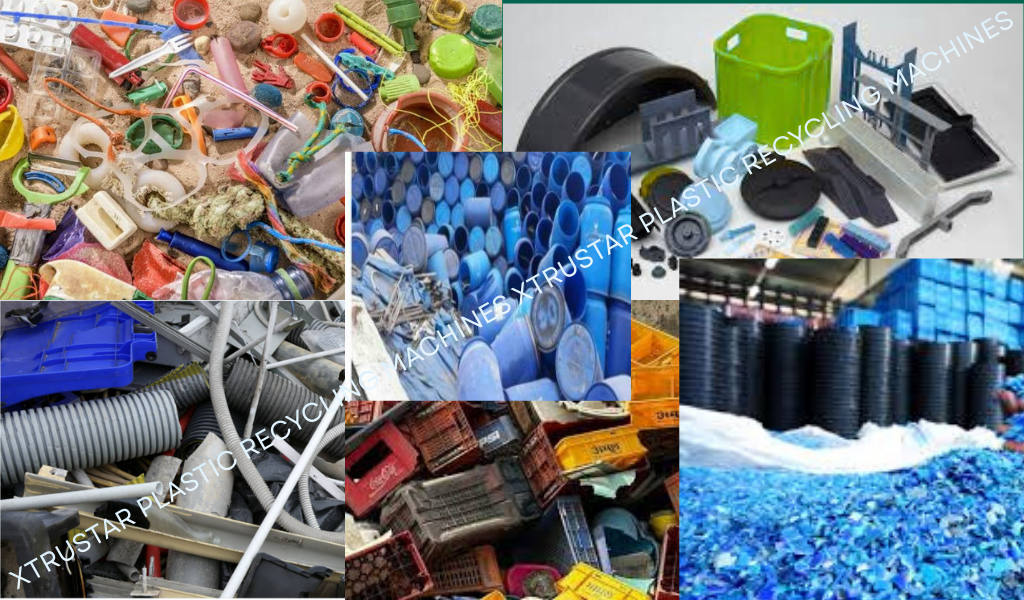
Recommended Recycling Configurations for Rigid Plastic Articles
| Feedstock Type | Typical Polymers | Machine Configuration | Venting | Notes |
| Injection scrap, molded rejects | PP, HDPE | Single Stage | Optional | Clean, dry material |
| Industrial rigid waste | PP, HDPE, PS | Single Stage Vented | Yes | For moisture & odor |
| Mixed rigid scrap | PP / HDPE mix | Double Stage | Yes | Stable pellet quality |
| Contaminated rigid waste | PP, HDPE | Three Stage | Yes | Washing + filtration |
Rigid plastic articles differ fundamentally from film waste due to higher bulk density, uniform wall thickness, and predictable melting behavior. Unlike film feedstock, rigid regrind feeds consistently into the extruder, allowing stable pressure build-up and controlled shear generation. This makes single-stage and vented single-stage extrusion sufficient for most industrial rigid scrap, while double-stage or three-stage systems are typically reserved for contaminated, mixed, or post-consumer rigid waste streams.
Common polymers processed in rigid article recycling include HDPE, PP (homo and copolymer), PS, and impact-modified grades. These materials exhibit low moisture sensitivity compared to films, reducing dependence on aggressive degassing. Proper size reduction, metal separation, and controlled melt filtration remain critical to ensure screw life, melt stability, and pellet consistency.
The Difference
Compared to film recycling lines, rigid plastic recycling machines prioritize torque capacity, screw root strength, and wear resistance over extreme venting performance. The process window is wider, but mechanical contamination risk is higher, making robust screw design and filtration more critical than vacuum efficiency.
End Note
Rigid plastic article recycling is best suited for stable feedstock streams such as in-house production waste, industrial scrap, and pre-sorted post-consumer materials. Machine configuration should be selected based on contamination level rather than throughput alone.
For further technical details, contact XTRUSTAR.
Phone: +91-9227004488, Email: xtrustar.em@gmail.com