
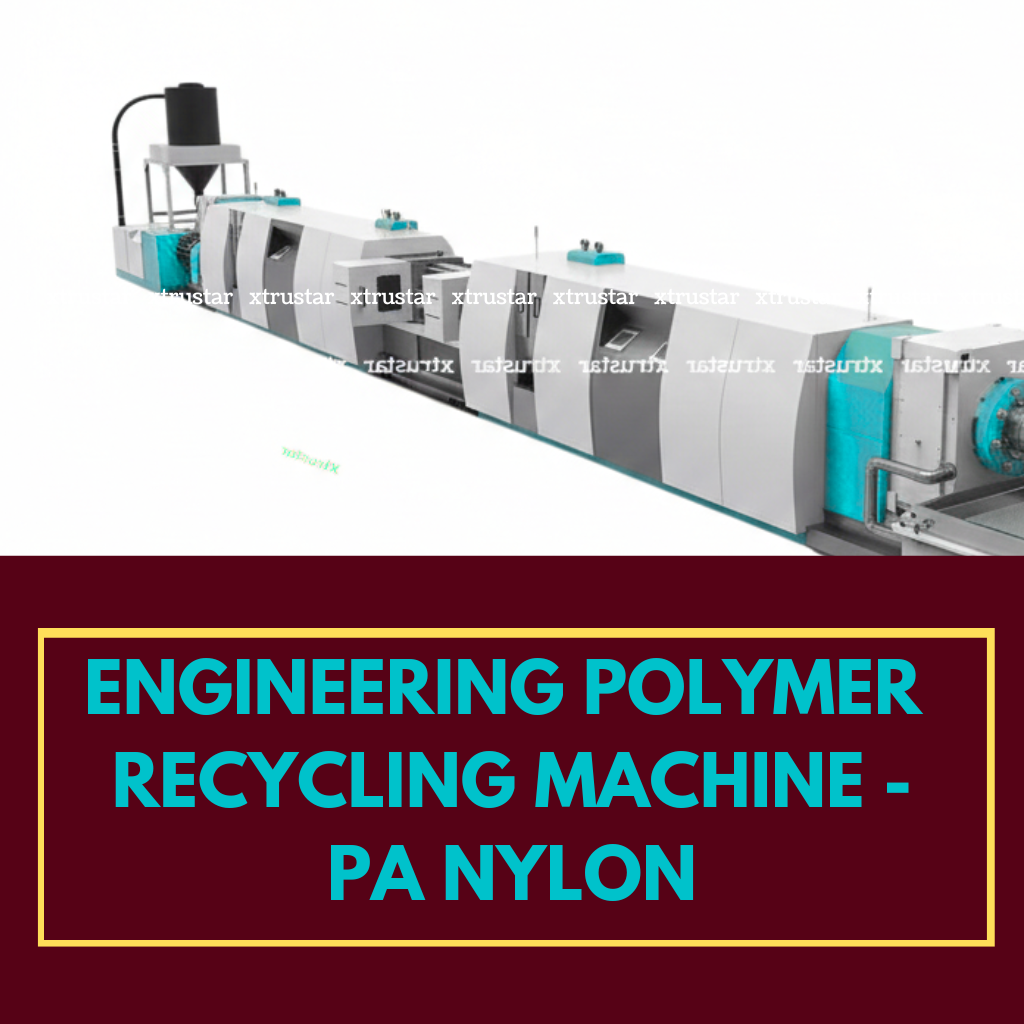
Part -1: Nylon Plastic Recycling by Extrusion
Nylon Recycling – Process, Challenges & Global Landscape
Nylon (also called polyamide) is a high-performance engineering plastic used in textiles, automotive parts, fishing nets, industrial components, and technical filaments. Its excellent strength, abrasion resistance, chemical stability and heat performance make it valuable in applications where durability is critical, but these same properties also pose significant recycling challenges.
Traditional mechanical recycling has limited uptake due to thermal degradation, moisture sensitivity and complex contamination. Less than 1% of certain nylon grades are recycled worldwide using conventional methods.
Nylon Grades & Recycling Complexity
Nylon 6 (PA6) is the most widely encountered recyclable nylon form, with a melting point around 220 °C, comparatively easier to process, and extensively used in textiles, carpets, fishing nets, fibres and industrial components.
Nylon 66 (PA66) has a higher melting-point (~260 °C) and stronger intermolecular structure, resulting in greater thermal stability and mechanical performance. It is widely used in automotive parts, technical mouldings and high-strength textiles, but this also makes it significantly more difficult to recycle by conventional melting or extrusion.
Other nylon types (PA 6,10; PA 6,12; PA 11; PA 12) vary in flexibility, moisture behaviour and heat performance, and their recycling pathways vary accordingly, often requiring tailored chemical or solvent systems.
Because of differences in polymer architecture, recycled nylon can behave differently than virgin material; maintaining mechanical property parity requires careful control of degradation and contaminants.
Mechanical or remelting recycling — sorting, shredding, washing, melting and pelletising — currently accounts for the majority of nylon recycling worldwide, especially for post-industrial scrap and relatively clean post-consumer textiles. It is widely implemented in the United States, China and Europe but remains limited in volume due to quality issues and thermal degradation that shortens polymer chains during re-melting.
Nylon Filament Recycling
Nylon filament — such as fibres from fishing nets, ropes, industrial threads, technical yarns or 3D printing feedstock — requires specialized handling. These fibrous forms trap contaminants deeply and often contain coatings, dyes or blended materials. Mechanical recycling of filament typically begins with aggressive shredding and cleaning to liberate fibres, followed by controlled melt or chemical recovery steps tailored to the specific polymer grade and intended reuse form.
Recycled nylon filament can be reprocessed into new fibres, engineering plastics or even additive-manufacturing feedstock; however, feedstock quality, polymer damage, and contamination control strongly dictate process choice and final product quality.
Challenges & Considerations
Despite technological advances, nylon recycling faces several key challenges:
Degradation during thermal reprocessing often leads to reduced molecular weight and compromised mechanical properties.
Moisture and contaminants accelerate hydrolysis and chain scission during melt processing, necessitating advanced cleaning and drying steps.
Grade separation is critical; mixing different nylon types (e.g., PA6 and PA66) complicates recycling due to different melting points and mechanical behaviour.
Efficient recycling therefore relies on feedstock quality control, crawler equipment, and tailored extrusion processes that minimise polymer damage.
Recycling success depends on purity + grade separation.
Table: Typical Nylon Feedstock Types
| Feedstock Category | Common Sources | Recycling Difficulty | Notes |
| Nylon 6 (PA6) | Fishing nets, yarn waste, films, molded parts | Medium | Most recycled nylon globally |
| Nylon 66 (PA66) | Automotive parts, gears, connectors | High | Higher melting, grade mismatch issues |
| Nylon Filament Waste | Textile spinning, BCF/CF yarn | Medium–High | IV & viscosity critical |
| Nylon Multimaterial | Fabric + coating, rubber bonded | Very High | Needs aggressive separation |
| Post-Consumer Nylon | Nets, carpets, ropes | High | Contamination + moisture |
Table: Nylon Recycling Machine Configurations
| Recycling Stage | Machine Type | Purpose |
| Pre-processing | Shredder + Washer + Dryer | Size reduction + moisture removal |
| Primary Melting | Single / Twin Screw Extruder | Controlled melting |
| Filtration | Piston / Backflush Screen Changer | Fine impurity removal |
| Degassing | Vacuum Vent (1 or 2) | Moisture & monomer removal |
| Pelletising | Strand / Water Ring | Stable pellet formation |
Table: Nylon Recycling Line Selection
| Feed Quality | Recommended Line |
| Clean industrial scrap | Single-stage vented |
| Filament waste | Double-stage with strong vacuum |
| Fishing nets / carpets | Double or three-stage |
| Mixed nylon grades | Chemical recycling preferred |
NYLON 6 vs NYLON 66 – RECYCLING COMPARISON (CORE GLOBAL ISSUE)
Nylon 6 vs Nylon 66 – Recycling Reality Table
| Parameter | Nylon 6 (PA6) | Nylon 66 (PA66) |
| Melting Point | ~220°C | ~260°C |
| Global Recycling Volume | Very High | Limited |
| Mechanical Recycling | Widely viable | Technically difficult |
| Chemical Recycling | Mature | Costly |
| Grade Compatibility | Flexible | Very sensitive |
| Market Demand (Recycled) | Strong | Selective |
| Common Failure | Moisture degradation | Thermal mismatch |
NYLON FILAMENT RECYCLING – SPECIAL CASE
Textile Focus
Nylon filament recycling demands strict control over moisture, viscosity, and thermal history. Unlike molded scrap, filament waste already has oriented molecular structure, which breaks down rapidly during remelting. Industrial filament recyclers therefore use low-shear screws, extended vacuum degassing, and fine filtration to preserve molecular weight. In BCF and CF yarn recycling, pellet output is often re-compounded or blended with virgin resin to restore spinnability.
The following extruder models are provided as reference configurations only.
Process stages (single, vented, double, three-stage) are explained separately on their respective pages.
MODEL NX-PA60
Single / Single-V Nylon Recycling Extruder (Reference)
| Parameter | Specification |
| Applicable Nylon | PA6, clean PA6 blends |
| Feed Form | Industrial scrap, filament waste |
| Screw Diameter | 90–120 mm |
| L/D Ratio | 32–36 |
| Degassing | Single or double vacuum vent |
| Filtration | Piston / continuous screen changer |
| Pelletising | Strand or water-ring |
| Typical Output | Medium to high (grade dependent) |
Designed for controlled melting of Nylon 6 with emphasis on moisture removal and viscosity stability. Suitable for textile and engineering reuse with blending.
MODEL NX-PA66
Heavy-Duty Nylon 66 / Filament Recycling Extruder (Reference)
| Parameter | Specification |
| Applicable Nylon | PA66, high-temperature nylons |
| Feed Form | Molded parts, automotive scrap |
| Screw Diameter | 120–150 mm |
| L/D Ratio | 36–40 |
| Degassing | Dual vacuum, deep vent |
| Filtration | Fine melt filtration system |
| Pelletising | Strand pelletiser |
| Typical Output | Medium (quality-focused) |
WHY NYLON EXTRUDERS ARE DIFFERENT
Nylon extrusion demands tighter control than polyolefins due to its hygroscopic nature, higher melting range, and sensitivity to thermal history. Screw design, vent depth, residence time, and filtration precision play a critical role in maintaining molecular weight and mechanical performance. Unlike PP or HDPE, nylon recycling success is primarily governed by moisture management and grade discipline rather than throughput alone.
END NOTE
These nylon extruder models are provided as reference architectures to align with global nylon recycling practices. Actual configuration depends on feedstock grade, contamination level, and intended end application. Process stage selection is detailed separately in the single-stage, vented, double-stage, and three-stage machine pages.
For further technical details, contact XTRUSTAR.
Phone: +91-9227004488, Email: xtrustar.em@gmail.com
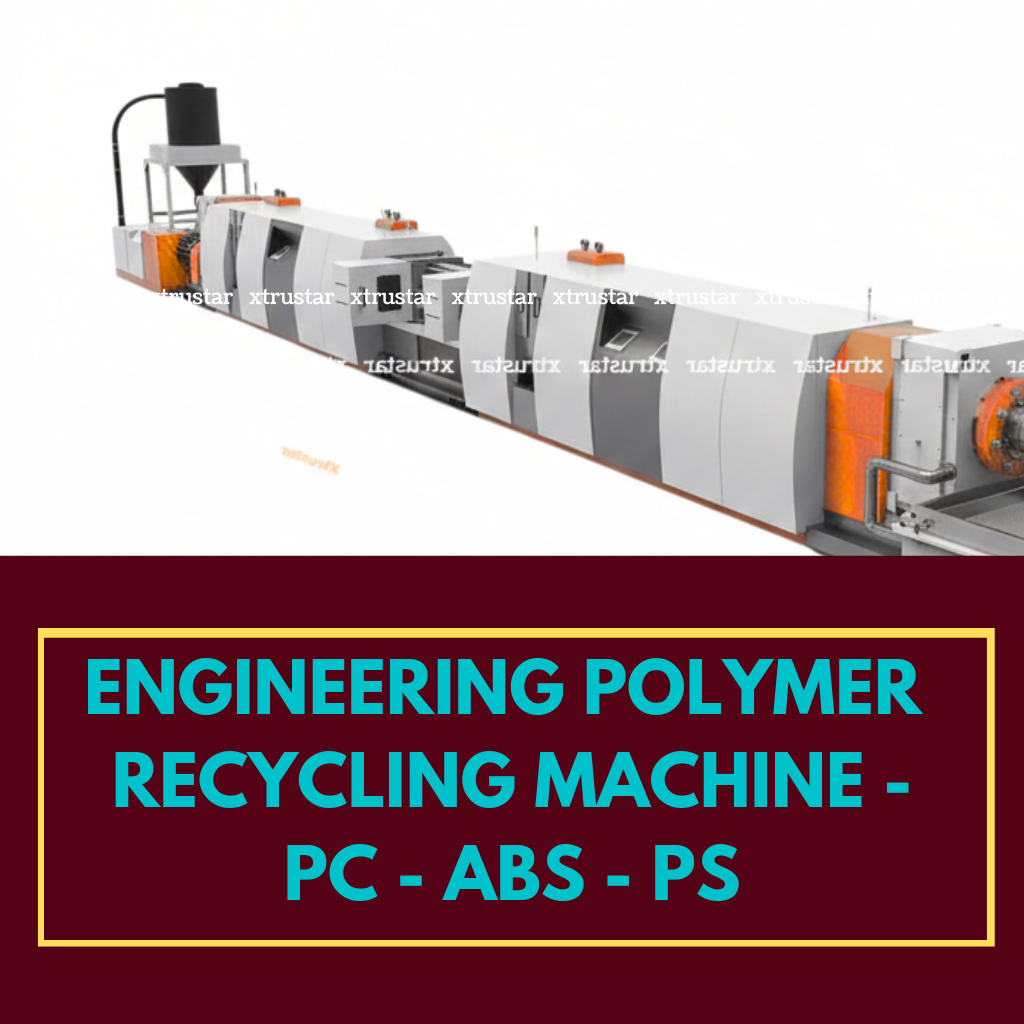
| Polymer | Recommended Machine Type | Key Technical Considerations |
| ABS | Single Stage Vented / Double Stage | Precise temperature control, effective vacuum venting to remove residual styrene, low-shear screw design to avoid surface burning and odor generation |
| PC (Polycarbonate) | Double Stage or Vented Single Stage | Strict moisture removal, controlled residence time, fine melt filtration, low degradation extrusion to preserve impact strength and transparency |
| PS / HIPS | Single Stage or Single Stage Vented | Lower processing temperature, odor management, smooth melt flow, avoidance of excessive shear to prevent brittleness |
Practical Focus – What to Watch Closely
ABS and PS are sensitive to thermal degradation and odor formation, making temperature zoning and vent efficiency critical. Polycarbonate demands aggressive drying and controlled extrusion due to rapid hydrolytic degradation. Across all three polymers, melt stability and filtration quality matter more than peak output, especially when recycling industrial scrap or mixed regrind.
XTRUSTAR recycling systems for ABS, PC, and PS are configured with polymer-specific screw design, controlled venting, and precise thermal management to match the processing behavior of each material. Detailed machine architectures are outlined across the Single Stage, Single Vented, Double Stage, and Three Stage recycling machine pages, with final selection based on feedstock condition, moisture sensitivity, and end-use requirements rather than nominal output alone.
For further technical details, contact XTRUSTAR.
Phone: +91-9227004488, Email: xtrustar.em@gmail.com
You are on page 12 of this website.