
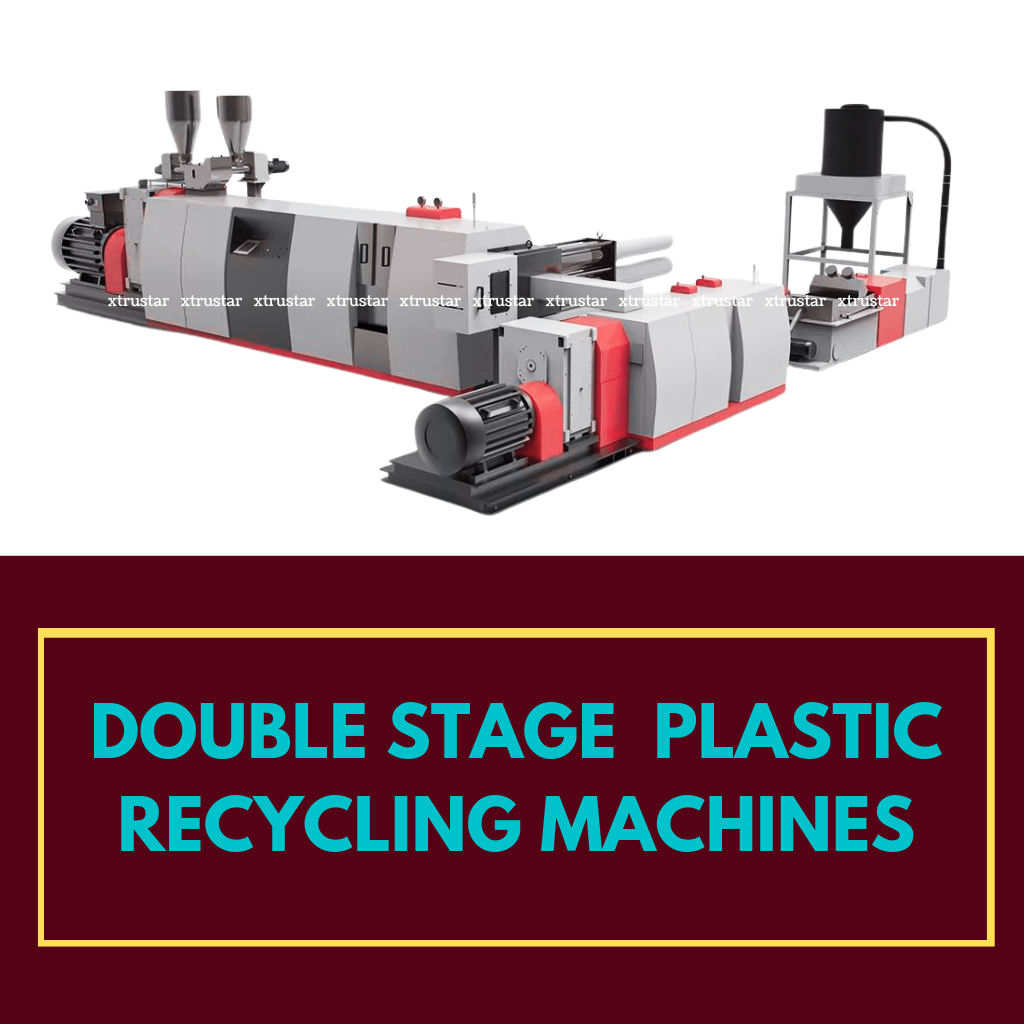
Stage 1: Degassing + Filtration
Stage 2: Melt Stabilization
Better impurity handling, More stable output
Double-Stage Recycling Extruder – Technical Chart (Mother-Baby Type)
| Model | Unit | XRDS 100/34-15 | XRDS 120/34-15 | XRDS 150/34-15 |
| Material Focus | — | PE/PP Films & Raffia + Rigid | PE/PP Films & Raffia + Rigid | Heavy Film + Rigid / Mixed |
| Output (Clean Film / Rafia) | Kg/hr | 200 – 250 | 280 – 350 | 450 – 550 |
| Output (Heavily Printed / Mixed) | Kg/hr | 150 – 200 | 220 – 300 | 380 – 450 |
| 1st Stage Screw Dia | mm | 100 | 120 | 150 |
| 1st Stage L/D | — | 34:1 | 34:1 | 34:1 |
| 2nd Stage Screw Dia | mm | 15 (Baby) | 15 (Baby) | 15 (Baby) |
| 2nd Stage L/D | — | ~12–15:1 | ~12–15:1 | ~12–15:1 |
| Degassing Zones | — | Dual Vacuum + Vent Ports | Dual Vacuum + Vent Ports | Dual Vacuum + Vent Ports |
| Filtration | — | Dual Screen Changers | Dual Screen Changers | Dual Screen Changers |
| Pelletising Type | — | Strand & Die-Face | Strand & Die-Face | Strand & Die-Face |
| Power – Main Extruder | kW | 90-110 | 110-132 | 150-185 |
| Power – Baby Extruder | kW | 15-22 | 22-30 | 30-45 |
| Force Feeder / Agglomerator | — | Optional* | Optional* | Optional* |
*Optional force feeder or cutter compactor recommended for high-bulk films / raffia.
[Specifications may vary based on material condition and process configuration.]
Technical Notes – Double-Stage Recycling
1) Material & Application Scope
Double-stage vented lines are designed for high-moisture, heavily printed, sticky, low-bulk density materials such as washed or post-consumer LDPE / LLDPE / HDPE films, PP raffia / woven bags, printed film waste, mixed flexible scrap, and rigid article regrind. Single vacuum + venting in one stage is often insufficient for these; two stages improve melt stability, degassing and filtration.
2) Why Two Stages (Mother + Baby)
Mother extruder: primary melting, aggressive filtration and initial degassing; handles bulk, moisture and heavy printing.
Baby extruder: homogenizes melt, stabilizes pressure, further degasses and conditions for pelletising.
This dual action gives better pellet quality, lower gels/odour, and improved throughput stability vs single stage.
3) Screw Diameter & L/D Configuration
1st stage: screw dia ≥ 100–150 mm, L/D ≥ 34:1 — supports thick, difficult melts from films/raffia; provides enough residence time and vent space.
2nd stage: screw dia ~ baby 15 mm smaller than main; L/D ~ 12–15:1 — for better melt refinement and degassing.
4) Degassing & Filtration
Vent ports and dual vacuum zones in both stages ensure moisture and volatile removal from high-bulk materials.
Dual / hydraulic screen changers reduce downtime and improve melt purity.
These are essential for printed films / laminated waste / raffia with contaminants.
5) Pelletising Options
Strand pelletiser: preferred for cleaner pellets and higher bulk density — better for film and raffia blends.
Die-face cutter: good for higher throughput and compact layout — often used when output demands are high and film is already stable.
Both are common worldwide and integrated into two-stage lines.
6) Typical Output Ranges (World Practice)
Film + Raffia (clean): ~200 – 350 kg/hr (100–120 mm models)
Printed / Mixed Waste: ~150 – 300 kg/hr
Heavy or Mixed Rigid + Film: ~380 – 550 kg/hr
These ranges may vary with moisture, contamination and pre-treatment.
8) Final Recommendation
Choose a double-stage vented line when:
Material has moisture / heavy printing / contamination
You want consistent pellet quality, fewer gels
Handling raffia / woven waste with film scrap
Need stable throughput + degassing + filtration
Using dual screw diameters (100–150 mm) + L/D ≥ 32 in main gives an all-around solution.
In raffia recycling, a two-stage extrusion system is preferred because PP raffia waste (woven bags, FIBC cuttings, jumbo bags) has low bulk density, uneven contamination, and highly unstable melt behavior. The first stage uses a long L/D, high-shear screw for controlled plasticization, while the second stage operates at low RPM for melt homogenization, pressure stabilization, and safe removal of dust, fibrillation residues, and volatiles through venting. Under Indian operating conditions—where material quality, moisture level, and feed consistency vary widely—a two-stage line delivers stable die pressure, longer screen life, and consistent MFI suitable for tape-grade PP, which is difficult to achieve reliably in single-stage systems.
For further technical details, contact XTRUSTAR.
Phone: +91-9227004488, Email: xtrustar.em@gmail.com
You are on page 07 of this website.