
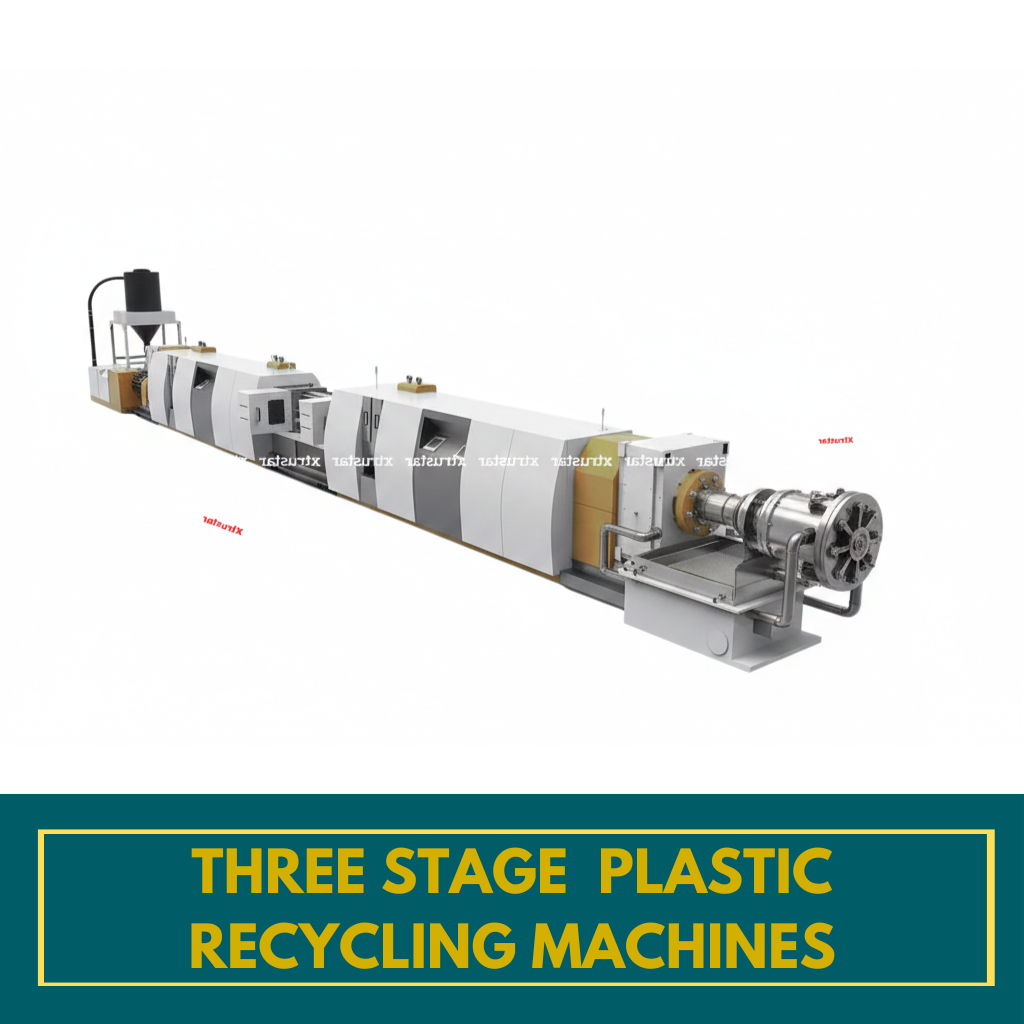
Three Stage Recycling Line – Heavy Contamination / Roadside Waste
| Model | Stage Configuration | Screw Dia (mm) | L/D Ratio | Venting | Filtration | Pelletising | Typical Application |
| XRTS 120/34 + 100/30 + 90/24 | Mother → Intermediate → Baby | 120 → 100 → 90 | 34 / 30 / 24 | Double Vent (Stage 1 & 2) | Double Hydraulic Screen + Final Polishing Screen | Die Face / Strand | Mixed roadside plastic, film + rigid + dust |
| XRTS 135/36 + 110/32 + 100/26 | Mother → Mother → Baby | 135 → 110 → 100 | 36 / 32 / 26 | Triple Vent (Vacuum Assisted) | Continuous Screen + Dual Backflush | Die Face Cutter | Post-consumer waste, MRF output, high contamination |
| XRTS150/36 + 120/32 + 110/26 | Heavy Mother → Refining Mother → High-Output Baby | 150 → 120 → 110 | 36 / 32 / 26 | Triple Vent (Deep Degassing) | Melt Pump + Fine Filtration | Die Face (Underwater optional) | Urban waste, multilayer mix, low-grade input |
Process Overview
Three-stage recycling systems are applied where input material quality is highly inconsistent and cannot be stabilized through washing or pre-processing alone. Roadside collected plastic, post-consumer municipal waste, and MRF (Material Recovery Facility) output typically contain mixed polymers, high moisture, dust, paper fibres, organic residues, and volatile contaminants. In such cases, single or two-stage extrusion systems fail to maintain melt stability, screen life, and pellet consistency. A three-stage configuration allows progressive melt conditioning, controlled degassing, and pressure stabilization across multiple extrusion zones, enabling reliable pellet production from otherwise unprocessable material streams.
Stage Functionality
In a three-stage line, the first extruder functions as a heavy-duty melting and contamination-handling unit, designed to absorb feedstock variability and initiate degassing under high shear. The second stage acts as a refining extruder where melt homogenization, secondary degassing, and pressure balancing occur, significantly reducing fluctuations caused by moisture and entrapped gases. The final stage operates at lower RPM and controlled temperature to deliver stable melt flow through fine filtration, ensuring consistent pellet shape, density, and bulk flow during pelletizing.
Material Scope
Three-stage systems are suited for mixed LDPE and LLDPE film, PP film and rigid combinations, roadside-collected plastics, and post-consumer waste after basic sorting and metal removal. These systems are specifically engineered to tolerate wide MFI variation, contamination load, and feed density inconsistency that are typical in urban and municipal plastic waste streams.
Material Limitations
Even with three-stage extrusion, materials containing PVC, hazardous chemical residues, medical waste, or high-percentage PET blends are not recommended without prior separation. Such contaminants pose risks of corrosion, toxic gas release, and severe degradation of melt quality, which cannot be corrected through extrusion staging alone.
Venting and Degassing Requirement
Effective venting is fundamental to three-stage recycling performance. Vacuum venting with condensate separation is required to remove moisture, volatiles, and decomposition gases generated during melting. Atmospheric venting alone is insufficient under high-contamination conditions. Improper venting directly results in unstable pressure, surface defects in pellets, and accelerated screen blockage.
Output and Energy Consideration
Throughput in three-stage systems is governed by material condition rather than screw diameter alone. Compared to clean industrial scrap, output per millimeter of screw diameter is lower, and energy consumption is higher. However, the trade-off results in significantly improved melt stability, longer filtration life, and a usable pellet output from material that would otherwise be rejected or landfilled.
System Design Clarification
In established industrial practice, each three-stage extrusion line operates as an independent melt circuit with its own final extrusion and pelletizing unit. Feeding multiple primary extruders into a single downstream extruder is not standard due to melt pressure synchronization challenges, contamination risk, and process control limitations. High-output three-stage systems instead rely on appropriately sized final extruders, melt pumps, and filtration assemblies to maintain continuous and stable operation at elevated throughputs.
End Note
Three-stage recycling systems are process-driven solutions intended for extreme material variability, not capacity enhancement alone. Their application is justified only when material quality cannot be controlled at the source and consistent output is required from highly contaminated or mixed waste streams.
For material-specific three-stage configuration support, contact XTRUSTAR.
Phone: +91-9227004488, Email: xtrustar.em@gmail.com
You are on page 08 of this website.